
Changelog
Welcome to the changelog for the latest updates on our plugin! In this section, you'll find detailed information about the newest features, enhancements, and bug fixes that have been implemented.
Fixes and Bricks 2.4 support
The animations toggle and the AI panel disappeared from the builder toolbar after updating to Bricks 2.4, which stopped identifying its toolbar by id and started identifying it by class so it can be placed at the top, left or right. Both buttons are back, wherever the toolbar is placed, and older Bricks versions keep working
Sites updating from 2.x lost their license key. 3.0.0 started storing the key encrypted, but a key saved by an earlier version was plain text and could not be read back, so it was discarded. The plugin then checked for updates without a key, the server answered “no update”, and Settings still showed “Activated” because that was read from the stored activation message rather than from the key: updates stopped arriving and nothing said so. Existing keys are now recognised and re-saved encrypted automatically
AI Panel, Global Animations and Video scrub
New: you can now manage your account and your license from the Fancy Animations website. Go to My account, click Forgot your password? to set a password the first time, and from there you can see your license key, the sites you have it active on, and release any of them.
3.0.0 is the biggest update Fancy Animations has had. The main thing is the AI panel: you describe what you want and it adds the animations for you, on the canvas, before you save anything. There is also a new Global Animations panel and a good number of fixes.
Animate with a prompt
The panel sits in the Bricks toolbar. You write something like “elegant fade-in on all the cards” and it applies the animations. It looks at the page first, so it does not put the same effect on everything, and when it finds a repeated group like a card grid it puts the stagger on the parent, with the right column count.
You can run it on one element or on the whole page. If you do not like the result, tell it what to change and it adjusts instead of starting over. You can also ask it to remove animations: all of them, one type, or one specific effect. When it finishes you get a summary of what it did and with which settings, so you do not have to open every element to check.
Custom animations without writing CSS
This is the part I am happiest with. Before, if the animation you wanted was not in the library, you had to write it yourself: keyframes, transforms, and being careful not to break anything else on the page.
Now you describe it and the AI writes the CSS for you. It works for entrance and for scroll trigger, and what it generates only affects that element. You do not need to know CSS anymore.
You bring your own key, from Anthropic, OpenAI or DeepSeek. Each one keeps its own key and model, and the keys are stored encrypted.
See it live in the editor
Animations now render in the editor while you set them. Before you had to reload the builder to see how it looked, which made trying a delay or a different effect slow. Now you just see it.
Animate a whole site by selector
Global Animations lets you animate by CSS selector from the settings, without opening the builder. You pick h1, or .card, or whatever selector you want, and choose the animation. Each rule has its own timing and can be turned off without deleting it. You can exclude elements per rule, and there is a site-wide exclusion for things like the header, the footer or an off-canvas, so you do not have to repeat it in every rule.
Licensing and updates
Updates now go through the licensing server instead of shipping a GitHub token inside the plugin. Local and staging sites are detected and do not use up an activation, so you can develop without burning through your limit. And there is finally a button to remove the license from a site, which was missing until now.
Fixes worth knowing about
Text that stayed broken, one word per line, after removing a text animation. Stagger that kept animating the children after turning it off. Warnings on sites coming from older settings. A conflict with FluentCRM that left its email editor on a blank coloured screen. And Exclude URLs now accepts query strings, so you can exclude a page that is only reachable through a parameter.
New panel in the Bricks toolbar that adds animations from a plain-language prompt. Describe what you want (“elegant fade-in on all the cards”) and the animations are applied on the canvas, ready to review before saving
Scope selector: apply the prompt to the selected element only, or to every element on the page
Structure aware: reads element types, labels, nesting and child counts, then varies the animation per element instead of applying the same effect everywhere
Automatic stagger detection: recognises repeating groups (post loops, card grids, icon lists, team members, testimonials, pricing tables) and applies stagger on the parent, including per-breakpoint column counts
Custom animations without writing CSS: describe the movement you want and the AI writes it for you, for both entrance and scroll trigger. The generated CSS is scoped to that single element, so nothing else on the page is affected.
Conversational refinement: follow-up prompts adjust the previous result instead of starting over
Whole-page requests are sent in batches, with progress shown per batch, so a large page gets covered thoroughly instead of a handful of elements. If one batch fails the ones already applied are kept
Choose your provider: Anthropic, OpenAI or DeepSeek. Each keeps its own API key and model, so switching back and forth costs nothing
Model picker with plain names (Claude Haiku 4.5, GPT-5.6 Luna, DeepSeek V4 Flash…) and a note on what each is good for, instead of typing a model id
Summary of what was applied: one card per animation with the kinds of element that received it and the settings used, so a run can be checked without opening 27 elements
Removing animations now works on whole pages. Ask it to remove everything, a family (“the entrance animations”) or a specific effect (“the blur ones”) and the editor resolves it directly
A whole-page run that animates almost nothing says so, instead of reporting success
API keys are encrypted before being stored, and never returned by the REST API — only whether one is set, and a masked preview
New settings panel to animate elements site-wide by CSS selector, without opening the builder or editing elements one by one
Selector presets for common tags (h1–h6, p, a, button, img, section, article), or any custom CSS selector
Entrance or Text animation per rule, each with its own time and delay; text rules add a split mode (letters, words, lines)
Rules can be switched off individually without deleting them
Per-rule exclusion: each rule can skip elements matching a CSS selector, and anything inside one
Site-wide exclusion (“Never animate inside”): one selector that every rule skips, so headers, footers and off-canvas panels can be left alone without repeating it on each rule
Works with the Optimized CSS file option: animations used only by a global rule are kept in the optimized stylesheet
Local and staging installs are now detected and validate the license without consuming a per-site activation, so development sites no longer burn through the activation limit
Whole-page mode is not available with OpenAI, which applies only a couple of elements on large pages whatever the batch size. The reason is shown in Settings and in the panel; element scope and custom animations work normally
“Remove license” button in Settings. Until now a license could be activated but never removed, so moving the plugin to another domain left the activation consumed with no way to release it from the plugin
Video scrub: play, pause, or scrub a video element based on scroll position
Import / Export: back up and restore all plugin settings as a JSON file
The animation panels now apply classes, attributes and style variables through Etch’s own public API instead of driving the builder’s interface. Faster, and no longer tied to the editor’s markup or language
Update checks now go through the licensing server instead of shipping a GitHub token inside every copy of the plugin
The stored activation is re-checked every 12 hours, so an expired or revoked license is picked up automatically instead of staying valid until the next manual check
License data and the AI API key are encrypted at rest
Exclude URLs now accepts query strings. Pages that are only reachable through a parameter can be excluded on their own (`/?fluent_crm_block_editor=1`) without excluding the home page. Listed parameters must all be present, extra ones on the page are ignored, and a parameter written without a value matches any value
Animations now apply live without requiring a page reload when adding or changing controls
Turning “Stagger children” off in the builder now clears what it added. The children kept the parent’s animation class and their stagger delays, and the parent kept the inline opacity that cancels its own entrance animation, until the canvas was reloaded
A child with its own animation keeps it when stagger is removed from the parent: only the stagger delay is cleared
An element that lost its last animation class no longer keeps a stale `–fb-anim-name` custom property
Text stayed broken, one word per line, after removing a text animation from an element. Anything ever split kept an internal marker, and the next viewport resize re-split it even though it no longer had a text animation, leaving the pieces unstyled. Most visible in the builder, where changing the responsive width triggers it
Sites upgrading from an older layout of the stored settings no longer emit “Undefined property” warnings on every page load. Options added after the original set are now filled from the defaults in one place, for both the old and the current settings shape
Fixed a conflict with FluentCRM that left its email editor stuck on a solid transition-coloured screen with no content. Plugins that render standalone front-end pages can load the transition styles while blocking the script that reveals the page; the pre-reveal state is now tied to that script, so a page that never loads it renders normally
The transition background is no longer injected in the Etch builder, which could leave the canvas on a solid colour when “Trigger on” was set to Always
The Exclude hover selector is now applied correctly on the front end and reflected in the settings preview
FA enable toggle now initializes correctly on first load
Resolved a compatibility issue that prevented Gutenberg support from loading properly
Etch Builder integration and Page Transitions improvements

Configure, preview and manage all your Fancy Animations directly inside Etch Builder. Entrance animations, ScrollTrigger effects, text animations, hover interactions, mouse effects, animated backgrounds and custom cursors are now available from a native panel system integrated into the Etch toolbar. Plus, enjoy new page transitions, performance improvements and enhanced CSS optimization support.
Full panel system embedded in the Etch toolbar. Configure all Fancy Animations directly from the Etch editor without leaving the canvas
Add, remove, and preview entrance animations per element with timing, delay, trigger, loop, stagger, and behavior options
Assign scroll-driven animations (fade, zoom, slide, sweep, rotate, etc.) with start/end/from/to percent controls and per-animation invert option
Apply and configure text animations (blur, flip, wave, etc.) with time, delay, and word-split options (requires Text Animations enabled)
Select and preview hover effects (float, ring, wobble, zoom) directly on the canvas element
Configure mouse-follow and 3D parallax effects (requires Mouse Animations enabled)
Set up radial gradient and animated pattern backgrounds (requires Gradient BG enabled)
Configure per-element cursor text and image (requires Custom Cursor enabled)
Toggle in the toolbar to enable/disable live animation preview while editing
Visual dot indicators on panel buttons and the element tree showing which elements have animations configured
The optimizer now correctly scans Etch block for used classes (entrance, scroll, hover, text, mouse, and gradient BG).
Choose between Navigation only (transition plays on page links) or Always (transition also plays on initial page load)
Zoom Blur (zoom-in or zoom-out with configurable direction)
Corner (quarter-circle expanding from any corner: TL, TR, BL, BR)
Diagonal (left or right diagonal wipe)
Cascade: configurable number of columns
Early inline style + script injected in “ prevents white flash on page load for all transition types
Respects `prefers-reduced-motion` OS setting — transitions are skipped when the user has requested reduced motion
Significant code refactor for better reliability and reduced file size
Smoother dot and outline movement; improved performance on high-frequency pointer events
Reinvented Custom Cursor, Gutenberg Support & New Settings UI
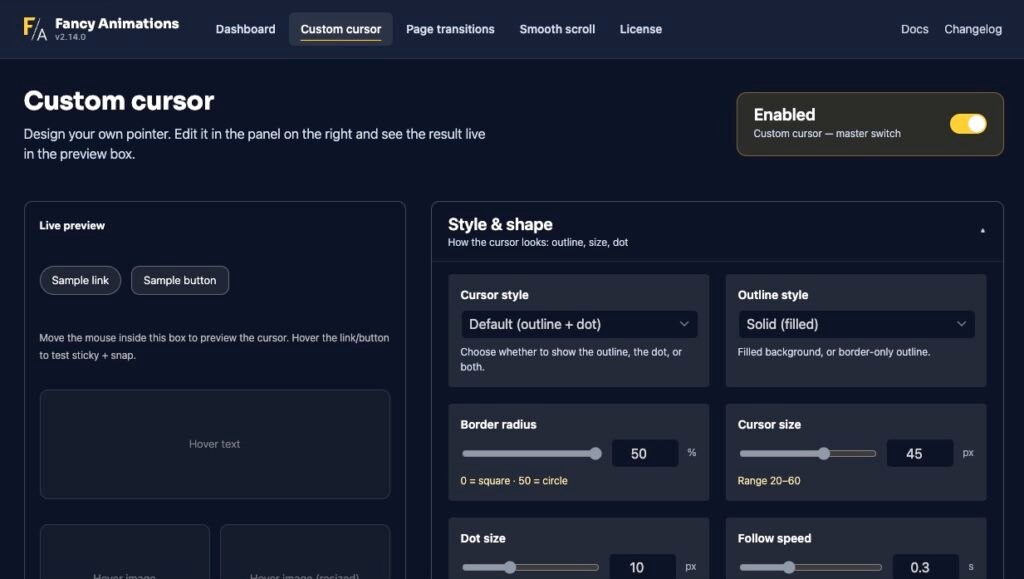
Version 2.13.0 is one of the biggest updates to Fancy Animations yet. The Custom Cursor has been completely rebuilt from the ground up, bringing new styles, blend modes, trail effect, click effects (ripple & shrink), sticky mode, dash-rotate, and fully configurable size, speed, and border radius.
On top of that, the entire plugin settings UI has been redesigned — Dashboard, Settings, Custom Cursor, Page Transitions, and Smooth Scroll pages all feature a new layout with a cleaner, more consistent look and feel.
This release also introduces beta support for Gutenberg: opt in from the Dashboard and start configuring entrance, scroll, text, mouse, gradient background, and custom cursor animations directly from the WordPress block editor sidebar — no Bricks required.
Finally, Custom Cursor, Page Transitions, and Smooth Scroll now work with any WordPress theme, opening Fancy Animations to a much wider range of projects. No breaking changes — all existing settings are preserved.
Major overhaul with new styles, blend modes, trail effect, click effects (shrink, ripple), sticky mode, dash-rotate, and fully configurable size, speed, and border radius
Configure cursor text or image directly from the Bricks style tab.
opt-in toggle in the Dashboard to enable Fancy Animations features inside the WordPress block editor (Gutenberg)
Entrance animations panel available in the block editor sidebar for every block
ScrollTrigger animations panel available in the block editor sidebar for every block
Text animations panel available in the block editor sidebar (requires Text Animations enabled)
Mouse animations panel available in the block editor sidebar (requires Mouse Animations enabled)
Gradient Background animations panel available in the block editor sidebar (requires Gradient BG enabled)
Custom Cursor per-element overrides panel available in the block editor sidebar (requires Custom Cursor enabled)
improved visibility toggles for Text, Gradient Background, and Custom Cursor panels
New layout for Dashboard, Settings, Custom Cursor, Page Transitions, and Smooth Scroll pages with a cleaner, more consistent look
Text Animations Upgrade: Line Splitting, Overlay Reveal & Better Bricks Compatibility
This release brings a major upgrade to text animations with new premium effects, per-line text splitting, improved styling control via CSS variables, and stronger compatibility with the latest Bricks Builder AJAX filtering.
New reveal effect where an overlay covers the text and animates away to uncover it, with color variants (primary/secondary/white/black).
Option to split text by visual lines (great for headings), while preserving inline styling and accessibility.
– Clip Reveal : Clean masked reveal with a premium feel.
– Swing 3D : 3D entrance with perspective rotation.
– Focus : Cinematic focus effect (blur to sharp) with depth.
– Wave : Dynamic pop/wave-style entrance.
Support for overriding text color using CSS variables in ScrollTrigger text animations for easier theming. https://fancyanimations.com/docs/overriding-text-reveal-color/
Animations now re-initialize properly after filtering/pagination on recent Bricks Builder versions.
Fixed preview page transitions
Resolved a conflict with Udoros “Bricks Mega Menu Pro”.
New Text animations controls
You now have more options for text animations.
Choose the viewport percentage at which the animation should fire
Top or fully visible — Decide whether to fire when the element’s top enters the viewport or when the element is fully visible
Decide which elements should animate only once on first view; you’re no longer forced to disable animations globally. The global “execute once” setting continues to work.
Optionally clear the visible state when scrolling back below the configured viewport threshold.
More control anf flexibility

This update brings major improvements to entrance animations, giving you greater control and flexibility
Choose the viewport percentage at which the animation should fire
Add dynamic, sequential delays to child elements without manually setting a delay per item
Decide whether to fire when the element’s top enters the viewport or when the element is fully visible
Register your own CSS entrance effects while leveraging all Fancy Animations entrance options (time, delay, loop, device rules)
Custom entrance effects now toggle `.fb-anim–custom-active` so you can attach additional styles and transitions
Optionally clear the visible state when scrolling back below the configured viewport threshold
Passive pointer listeners, ~16ms throttling, normalized deltas and robust cleanup when switching modes
Smooth scroll and more
This major update introduces Smooth Scroll with Lenis as the highlight feature, delivering buttery-smooth scrolling that makes animations feel more natural and responsive. Lenis provides a lightweight, accessibility-friendly alternative to GSAP’s scroll that works seamlessly with sticky elements and modern web standards.
Beyond smooth scrolling, this release brings highly requested features including customizable logo/image support for page transitions, granular control over one-time animations at the element level, and important fixes for border animations compatibility.
Animations feel more fluid with Lenis-powered scrolling. Lenis is lightweight and, unlike GSAP’s scroll, plays nicely with `position: sticky` and is more accessibility-friendly.
One of the most requested features: you can now show an image instead of loading text during transitions, including a max-width setting for consistent sizing.
Decide which elements should animate only once on first view; you’re no longer forced to disable animations globally. The global “execute once” setting continues to work.
The border effect now works correctly alongside hover animations on the same element and no longer overlaps the element background or clashes with transforms.
Compatibility with Megamenu and Slider improvements
Among the highlights, entrance and text animations are now compatible with megamenu elements when opened, allowing you to add more dynamism to your website. Compatibility with sliders has been improved, new states were added for greater animation control, a variable for customizing border radius was introduced, and scroll animations are now more precise.
PD: Esta actualización viene con una nueva plantilla avanzada para que veas el potencial de Fancy Animations con los sliders
Entrance and text animations now work inside your megamenu.
fa-next, fa-prev, fa-first and fa-last for greater control over custom animations.
Border animation now has a variable fa-border-radius for the radius that can be overwritten.
Entrance and text animations behave more reliably inside sliders
Scroll-triggered animations feel smoother with finer precision.
Animations only play on the current slide instead of all slides at once.
Radial Gradient Background Animations and more
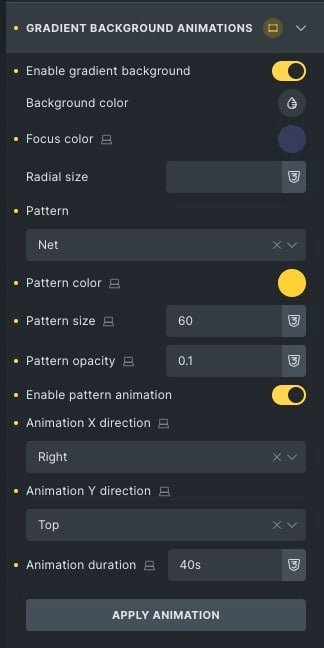
This update introduces radial gradient background animated with patterns and different options, you must activate it from the plugin options.
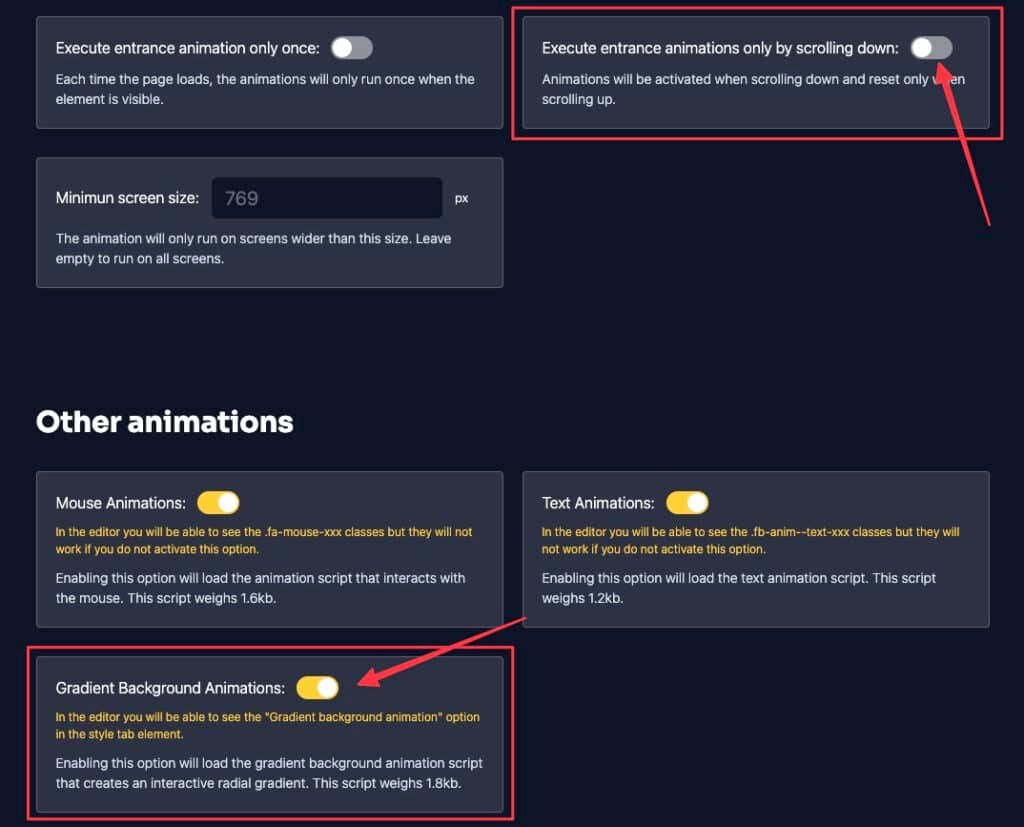
You can now also configure your entrance animations to only trigger when you scroll down in the plugin settings.
Provisional rendering of attributes in the editor
One of the big improvements is that you will now be able to preview animations added from the UI in the editor before applying them.
Compatible at the moment for entrance, ScrollTrigger, text, and background gradient animations.
Bricks builder natively does not allow to render attributes in the editor and requires reloading the page, this improvement was not easy to implement, I hope it will be very useful.
New update system
Lemon Squeezy caused me several headaches with automatic updates, this update implements a new update system that does not depend on Lemon Squeezy that will stop presenting errors when updating and detecting new versions.
You need to manually update to the latest version to enjoy automatic updates.
This update introduces radial gradient background animated with patterns and different options, you must activate it from the plugin options.
You can now also configure your entrance animations to only trigger when you scroll down.
You can now preview entrance, ScrollTrigger, text, and background gradient animations directly in the editor before applying them
New update system for more reliable and seamless updates